If you've typed "best reference book for class 10 maths" into Google, you already know the problem: everyone recommends RD Sharma or RS Aggarwal, nobody tells you which one fits your situation, and half the lists read like they were written by someone who's never actually opened these books. This guide won't do that. We'll walk through what each maths reference book for Class 10 is actually good at, where it falls short, and how to pick one without wasting money on a second book you'll never finish.
For most CBSE Class 10 students, RD Sharma paired with the NCERT textbook and NCERT Exemplar is enough to cross 90%+. Reach for a second book only if you're also prepping for a competitive entrance exam.
Do You Even Need a Reference Book for Class 10 Maths?
NCERT is not optional, a reference book is. The CBSE board paper is built directly from NCERT — a large share of the questions each year are lifted almost as-is from NCERT exercises and examples. So the honest starting point isn't "which reference book should I buy," it's "have I finished NCERT twice."
Where a reference book earns its place is in three gaps NCERT leaves open:
- Volume of practice — NCERT gives you enough questions to learn a concept, not enough to get fast at it under exam pressure.
- Question variety — reference books throw harder, twisted, and multi-step versions of the same concept at you, which is closer to what a board paper's higher-order thinking (HOTS) questions look like.
- Structured revision — chapter summaries, formula sheets, and mind maps that NCERT doesn't provide.
If you're aiming for a safe 80-85%, NCERT plus its Exemplar will get you there. If you're aiming for 95+, or you're also eyeing NTSE, JEE Foundation, or Olympiad-style prep, a reference book stops being optional.
How to Choose a Maths Reference Book for Class 10 (Without Guessing)
Most lists skip this and jump straight to book names. But the "best" book depends on things specific to you:
- Your current level. A student who's shaky on basics needs a book with more solved examples and simpler language before more exercises. A student who's already scoring 85%+ needs harder, more varied problems, not more repetition of easy ones.
- Time left before boards. [EDIT: if this post is timed to a season — say, published in June for the new academic year vs. published in December for exam-crunch time — tighten this line to match. Right now it's written to work either way, but a specific time-of-year angle will read more current.]
- Whether you're also prepping for a competitive exam. RD Sharma-style depth pays off for JEE/NTSE aspirants. It's often overkill if boards are your only target.
- Alignment with the current syllabus. CBSE's Class 10 Maths syllabus and exam pattern were revised for the 2025-26 session, with a heavier shift toward competency-based and case-study questions and the board now running exams in two phases (a mandatory main exam and an optional improvement attempt). Buy the latest edition — an older edition built for the previous pattern will have fewer competency-based and case-study questions, which is exactly the format CBSE has been leaning into.
- Whether you need Standard or Basic level. CBSE offers two Maths papers for Class 10 — Standard and Basic. Most reference books cover Standard-level questions by default since Basic-level students mostly rely on NCERT; check the cover before buying if you've opted for Basic.
The Best Reference Books for Class 10 Maths, Compared
Here's the honest breakdown of the books that consistently show up in toppers' lists and school recommendations.
1. NCERT Exemplar Problems — Mathematics
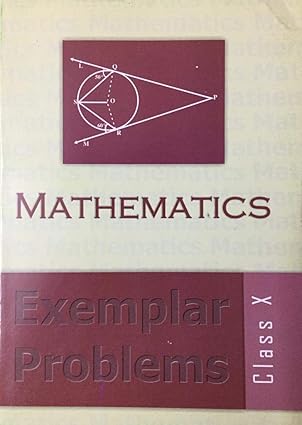
Not technically a "reference book" in the traditional sense, but it's the first stop before you buy anything else. It takes NCERT concepts and asks them in slightly twisted, higher-order ways — which is exactly the direction CBSE question papers have been moving. Thin, inexpensive, and non-negotiable.
- Best for: every student, regardless of level, before moving to a thicker reference book.
- Watch out for: no worked solutions in the book itself — you'll need a solutions guide or teacher support alongside it.
Where to buy: Mathematics Exemplar Problems Class X
2. RD Sharma — Mathematics for Class 10
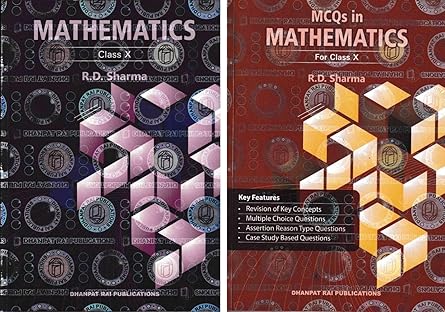
The book everyone mentions first, for good reason and one real drawback. RD Sharma is comprehensive — it has more solved examples per concept than almost any other book, and its harder problems genuinely resemble competitive-exam-level questions. That depth is also its weakness: it's thick, and a student trying to solve every question in every chapter will run out of time before boards.
- Best for: students who want deep conceptual clarity, and anyone also preparing for NTSE, JEE Foundation, or Olympiads.
- How to actually use it: don't attempt every question. Solve the worked examples in each chapter first, then pick the "Level 2" or higher-difficulty exercises selectively for chapters you're weak in — not all 15 chapters.
Where to buy: Mathematics Class 10 by R.D. Sharma
3. RS Aggarwal — Secondary School Mathematics for Class 10
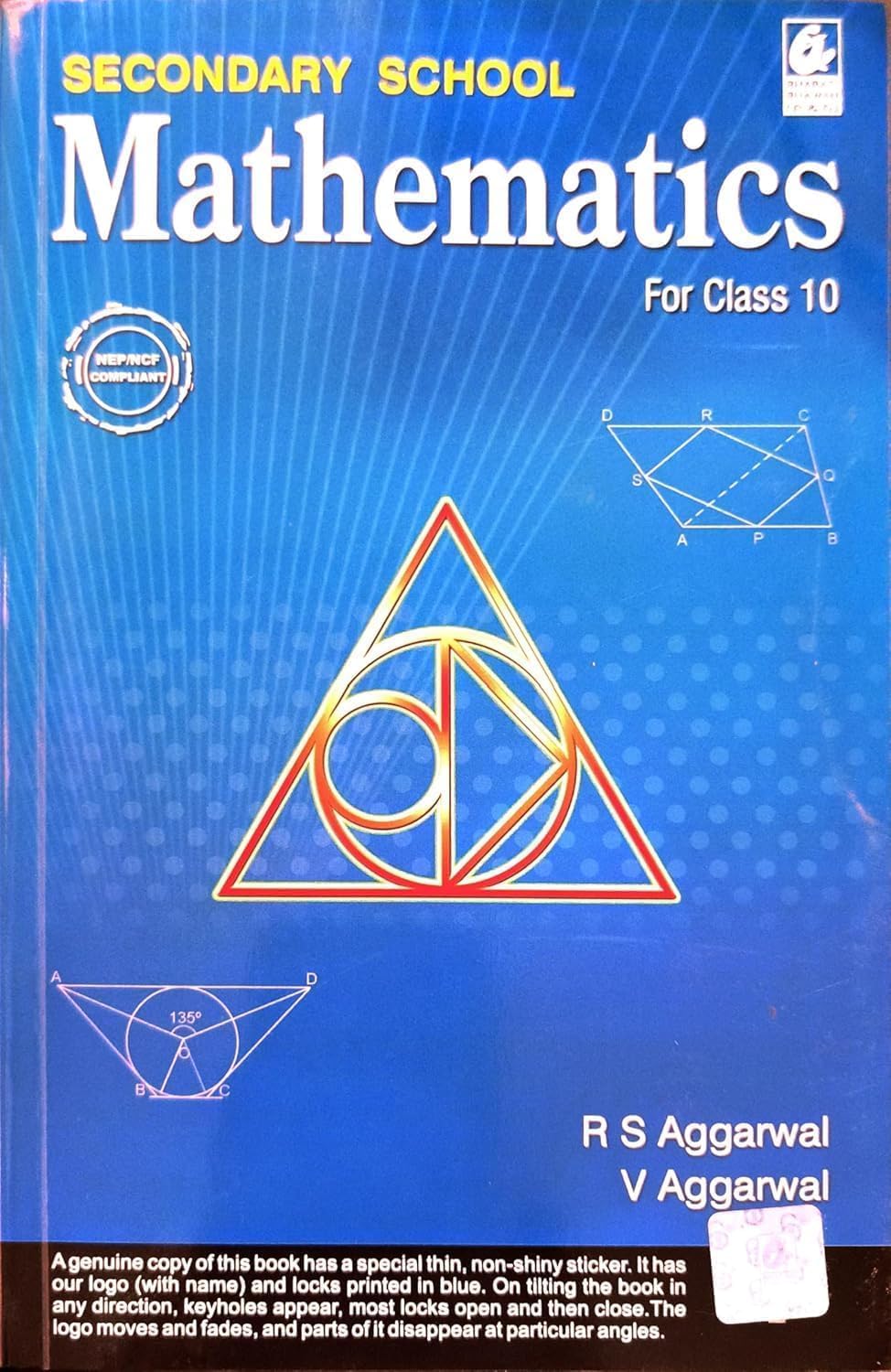
Thinner and more board-focused than RD Sharma. The question difficulty stays closer to what actually shows up in a CBSE paper, which makes it faster to finish cover-to-cover. It's the book most commonly recommended for students who want solid board-exam practice without the time investment RD Sharma demands.
- Best for: students whose only goal is the board exam, and students who found RD Sharma too dense to finish.
- Watch out for: less depth on the genuinely hard, multi-concept problems — supplement with a few RD Sharma chapters if you're aiming for a near-perfect score.
Where to buy: RS Aggarwal Class 10 Maths Book
4. Oswaal CBSE Question Bank — Mathematics (Standard/Basic)
Built around the exact CBSE paper structure rather than chapter-by-chapter depth. Includes previous years' questions, sample papers, and increasingly, the competency-based/case-study formats CBSE has been introducing.
- Best for: the final 2-3 months before boards, when your priority shifts from "understanding concepts" to "practicing the exact paper format."
- Watch out for: it assumes concepts are already clear — it's a practice book, not a teaching one.
Where to buy: Oswaal CBSE Class 10 Mathematics
5. Xam Idea — Mathematics
A revision-first book: chapter summaries, formula sheets, and mind maps rather than exhaustive question sets. Most useful in the last month before the exam when you need to consolidate rather than learn fresh material.
- Best for: quick pre-exam revision, and students who've already built a strong base and just need recall practice.
Where to buy: Xam idea Mathematics Class 10
6. Together With Mathematics
Similar positioning to Xam Idea — chapter summaries plus a solid question bank — and a common alternative if you prefer its layout or your school specifically recommends it.
Note: Our Class 10 Maths faculty at Edudrona typically assign RD Sharma's worked examples as homework and reserve RS Aggarwal for timed practice tests.
Where to buy: Together with CBSE Class 10 Question Bank Mathematics
RD Sharma vs RS Aggarwal for Class 10: The Comparison Everyone's Actually Searching For
This is the single most common question students ask about Class 10 Maths reference books, so it deserves its own straight answer instead of being buried in a list.
| |
RD Sharma |
RS Aggarwal |
| Depth of concepts |
Very high — more solved examples per topic |
Moderate — enough for board-level clarity |
| Question difficulty |
Wide range, includes competitive-exam-level problems |
Board-exam-level, fewer extreme outliers |
| Book length |
Long, harder to finish cover-to-cover |
Shorter, more finishable in limited time |
| Best suited for |
Students also targeting NTSE/JEE Foundation, or aiming for a near-perfect score |
Students whose only target is the board exam |
| Time investment |
High |
Moderate |
If you genuinely have to pick one: RS Aggarwal is the safer choice for most board-only students because you're more likely to actually finish it. RD Sharma is worth the extra time if you're strong in maths already or have a competitive exam in view. Using both cover-to-cover is rarely necessary — that's over-preparation for one subject at the cost of the other four.
Which Book Should You Buy, Based on Where You're Starting From?
- Weak in Maths, aiming to just clear comfortably (60-75%): NCERT + NCERT Exemplar is genuinely enough. Skip a thick reference book — it'll overwhelm more than it helps.
- Average student, aiming for 80-90%: NCERT + NCERT Exemplar + RS Aggarwal.
- Strong student, aiming for 95+ or a competitive exam alongside boards: NCERT + NCERT Exemplar + RD Sharma, with Oswaal's question bank added in the final two months for paper-pattern practice.
- Anyone in the last 4-6 weeks before the exam, regardless of level: add Xam Idea or Together With for revision, and previous years' papers — CBSE has been shifting more marks toward competency-based and case-study questions, so recent papers matter more than they used to.
How to Actually Use a Reference Book (Most Students Get This Wrong)
Buying the right book solves maybe a third of the problem. Where most students lose marks isn't book choice — it's using the book badly.
- Finish NCERT first, every time. A reference book on top of a shaky NCERT foundation just adds confusion, not marks.
- Don't solve every question in a reference book. Solve the worked examples fully, then pick exercises selectively based on which chapters you're weak in. Trying to complete all of RD Sharma, for instance, is a common reason students run out of revision time.
- Keep a formula sheet as you go, rather than making one in the last week. Chapters like Trigonometry, Coordinate Geometry, and Circles lean heavily on formula recall under time pressure.
- Time yourself on at least one full chapter test per week once you're past the learning phase — reference books rarely simulate the 3-hour exam clock, so you have to build that discipline separately.
- Track your mistakes, not just your scores. Mark every question you got wrong, and revisit only those in the final revision round instead of re-solving the whole book.
Common Mistakes Students Make With Class 10 Maths Reference Books
- Buying two or three books "to be safe." This usually backfires — you end up half-finishing all of them instead of fully finishing one.
- Starting a reference book before finishing NCERT. Board papers draw heavily from NCERT itself; skipping ahead means missing marks you were guaranteed to get.
- Ignoring the edition year. An old edition won't reflect CBSE's current competency-based question format, and can leave you underprepared for exactly the question types the board has been increasing.
- Treating a reference book as a substitute for practice papers. Reference books teach concepts and variety; only previous years' papers and sample papers teach you the actual exam format and time pressure.
FAQs: Reference Books for Class 10 Maths
Is a reference book necessary for CBSE Class 10 Maths, or is NCERT enough?
NCERT plus NCERT Exemplar is enough for a safe pass and a solid score in the 80s. A reference book becomes worth it if you're aiming for 95+ or preparing for a competitive exam alongside boards.
Which is the best reference book for Class 10 Maths — RD Sharma or RS Aggarwal?
RS Aggarwal for students who only need board-exam-level practice and want to actually finish the book. RD Sharma for students who want deeper problem-solving practice or are also targeting NTSE/JEE Foundation.
Can I use RD Sharma and RS Aggarwal together?
You can, but it's usually not necessary and can eat into time you need for other subjects. If you do combine them, use RD Sharma for concept depth and RS Aggarwal for timed board-format practice, rather than solving both cover-to-cover.
Which reference book is best for the last month before Class 10 boards?
A revision-focused book like Xam Idea or Together With, alongside a question bank like Oswaal for paper-pattern practice — not a concept-heavy book like RD Sharma, which is better used earlier in the year.
Do reference books cover the 2026 CBSE two-phase exam pattern?
The syllabus and question pattern are the same across both the main exam and the optional improvement exam CBSE now offers, so a reference book aligned to the current syllabus covers both. Just confirm you're buying the latest edition, since older editions may not reflect the recent shift toward competency-based and case-study questions.