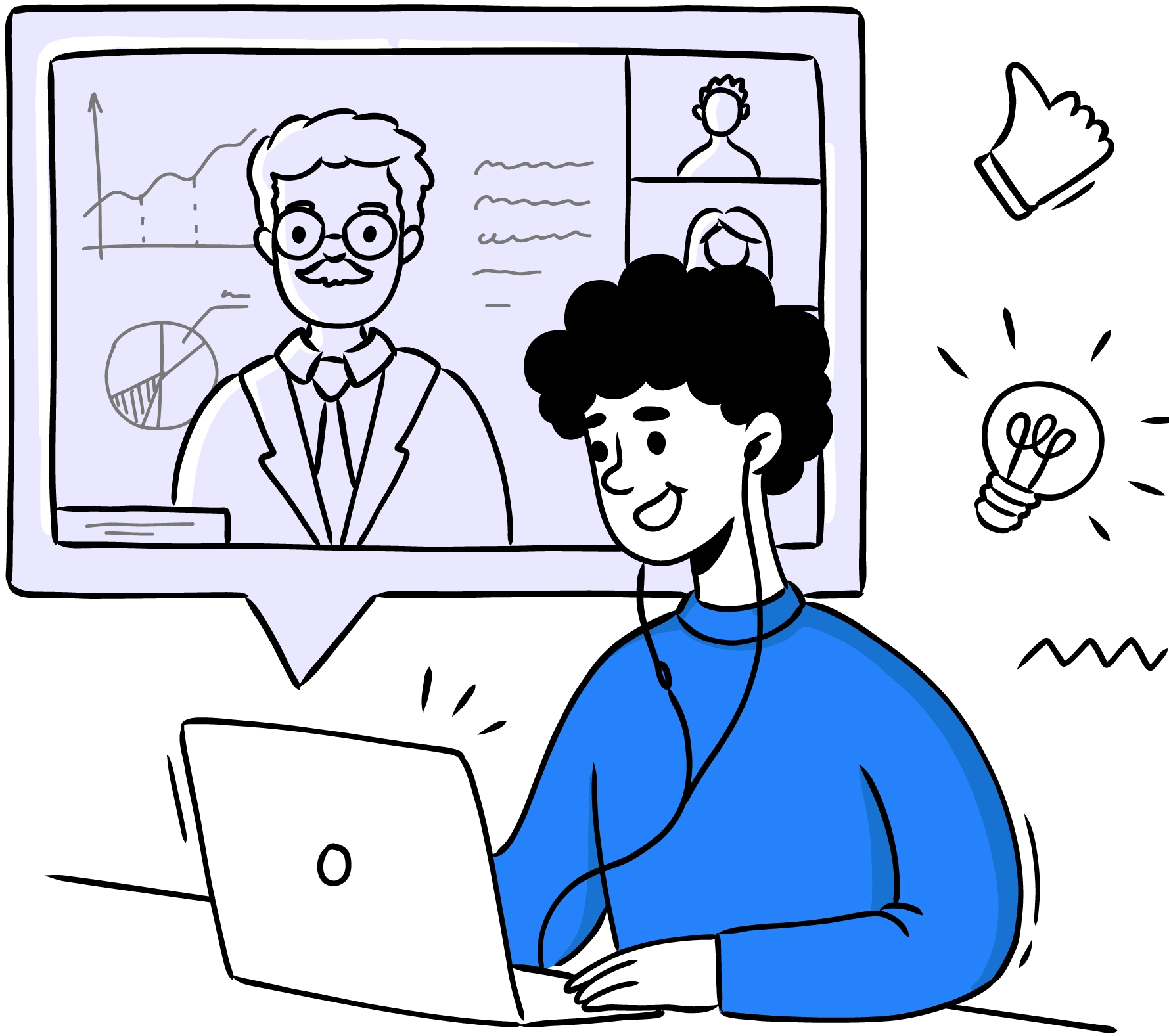
Select from a rich variety of seasoned tutors to achieve fluency in your chosen language.

Engage in tailored live chat sessions with your tutor, fostering a profound grasp of the language.

Experience a boost of inspiration and energy while refining your social interaction skills through our dynamic group lessons.



Find the Right Tutor for Any Subject
Get personalized 1-on-1 lessons with expert tutors to achieve your learning goals – anytime, anywhere.
Physics becomes difficult when formulas are memorised before the ideas behind them are understood. A chapter may seem clear in school, yet the first unfamiliar numerical can leave a student unsure where to begin. Edudrona’s online physics tuition gives students the time and individual attention to work through that gap.
In live one-to-one classes, the tutor can see how the student approaches a question, correct the exact step causing confusion and adjust the lesson around the student’s school syllabus and pace. The aim is not to rush through chapters. It is to help the student understand the concept, represent it correctly, choose the right principle and solve with confidence.
Whether the immediate need is to catch up with school, prepare for an examination or strengthen the foundation for higher classes, the learning plan starts with the student, not a fixed batch schedule.
These classes are designed for students who need focused, live support rather than another stream of recorded explanations. Physics tuition online can be useful when a student:
Students who are already doing well can also use one-to-one lessons to attempt mixed-concept problems, improve speed and accuracy, and explore the reasoning behind standard results in greater depth.
A student who is stuck on free-body diagrams does not need the same lesson as one who understands mechanics but loses marks in calculations. That is why Edudrona begins by understanding the learner’s present level, school requirements and goals.
The tutor can then decide what the next lesson should prioritise: rebuilding a prerequisite, teaching the current school chapter, practising a question type, revising for a test or reviewing mistakes from previous work. Because the session is live and individual, the student can stop, question a step and try the method again immediately.
Concept first: Ideas are explained with diagrams, examples and links to familiar situations before formulas are applied.
Guided problem-solving: The tutor models the reasoning, then gradually hands more of the solution to the student.
Visible working: Equations, substitutions, signs, units and diagrams are checked, not only the final answer.
Targeted practice: Questions are selected around the student’s weak areas and the pattern expected by the school or board.
Correction with context: Mistakes are discussed so the student understands whether the issue was conceptual, mathematical or procedural.
A useful Physics lesson is active. The student should spend part of the session explaining, drawing, calculating and checking, not simply watching the tutor solve questions. Depending on the topic and the student’s needs, a class may include:
The structure can change near school exams. Revision lessons may combine chapters, use timed questions and focus on presentation, while a remedial lesson may slow down and revisit the mathematical skill or earlier concept behind the current difficulty.
The way Physics is taught should change as the subject becomes more mathematical and specialised. The tutor matches the depth, notation and question practice to the student’s class and prescribed curriculum.
At the foundation stage, the priority is curiosity and clear reasoning. Lessons can help students observe patterns, read simple diagrams, understand measurements and connect topics such as motion, force, light, sound, heat, electricity and magnetism with everyday examples. This makes the transition to formal Physics less abrupt in later classes.
In Classes 9 and 10, students begin using definitions, laws, equations, graphs and numerical methods more systematically. Tuition can support chapter understanding, textbook exercises, school assignments, practical-based questions and exam revision. Particular attention is given to writing complete steps and using the correct units, symbols and diagrams.
Class 11 often feels like a jump because several chapters require Physics concepts and mathematical fluency to work together. Our class 11 physics tuition can help students build a reliable approach to vectors, kinematics, laws of motion, work and energy, rotational motion, gravitation, properties of matter, thermodynamics, oscillations and waves, subject to the student’s current syllabus.
Instead of learning each formula in isolation, students practise deciding what is known, what must be found, which assumptions apply and how one idea connects to another. Students seeking support across subjects can also explore our class 11 online tuition classes.
Class 12 demands conceptual understanding as well as consistent written practice. Our class 12 physics tuition can cover electrostatics, current electricity, magnetism, electromagnetic induction, alternating current, optics, dual nature, atoms, nuclei and semiconductor electronics, according to the applicable board syllabus.
Lessons can be organised around school pace, board-exam revision or specific weak chapters. Students are encouraged to explain diagrams and reasoning, write derivations logically and review errors from past questions. For broader academic support, visit our class 12 tuition classes page.
A strong concept remains the same, but the order of chapters, expected depth, terminology and examination style can vary by board and class. The tutor should therefore use the student’s current syllabus, prescribed textbook, school plan and recent question papers when shaping lessons.
Edudrona can match students with qualified tutors of different boards. Share the class, board, textbook and next assessment while enquiring so that the recommended tutor and plan are relevant from the first lesson.
Solving a Physics numerical is not just about finding a matching equation. Students need to translate words into a physical situation, choose a system, draw or visualise it, identify known quantities, apply a law and check whether the result makes sense.
During online physics tuition, the tutor can observe that entire process. If the student repeatedly chooses the wrong equation, the tutor can test whether the real problem is a weak concept. If the idea is clear but the answer is wrong, the lesson can focus on algebra, vectors, powers of ten, graph reading, units or sign conventions. This diagnosis is more useful than simply assigning more questions.
As an exam approaches, classes can shift from chapter learning to planned revision. A practical preparation cycle may include:
No ethical tutor can promise a particular score. What tuition can provide is a more organised process: clear teaching, deliberate practice, feedback and a record of the areas that still need attention.
Share the class, board, current chapter, school schedule, preferred timings and the areas causing difficulty.
Use the introductory session to see how the tutor explains, listens and responds to the student’s questions.
The first lessons should establish whether the student needs prerequisite repair, current-chapter support, exam revision or a combination.
Live lessons and focused practice create a cycle in which mistakes inform the next class.
Individual attention: The lesson can respond to one student’s questions, pace and misconceptions.
Live interaction: Students can ask questions, attempt problems and receive correction during the class.
Tutor matching: The choice of tutor can consider the student’s class, board, goals and preferred schedule.
Flexible learning: Online sessions remove travel and make it easier to build a consistent routine.
Connected subject support: Students who need help across science subjects can also explore chemistry online tuition and biology online tuition.
A good tutor should do more than know the answer. During an introductory class, notice whether the tutor checks what the student already understands, explains the reason behind each step and asks the student to participate. The tutor should be comfortable with the relevant board and class level, but teaching fit matters too.
Parents can ask four practical questions: How will weak areas be identified? What will the student do during the lesson? How will practice be selected? How and when will progress be communicated? Clear answers make it easier to compare physics tuition online on teaching quality, not only on price or claims.
Edudrona supports students for all grades. The right starting point depends on the learner’s class, board, present level and goal. Share these details while enquiring so the team can recommend suitable support.
Physics tuition is available for all the boards including ICSE, CBSE, and other state boards. Availability can depend on the class, curriculum and preferred timing, so please confirm these details with the team before enrolling.
Edudrona’s online tuition is designed around one-to-one learning, allowing the tutor to adjust the pace and practice to the individual student.
The tutor can use a digital whiteboard or shared screen to draw the situation, organise the data and demonstrate the reasoning. The student then attempts related questions while the tutor checks formula selection, substitutions, units, signs and final interpretation.
Yes. One-to-one support can be particularly useful when senior-secondary Physics becomes more mathematical and chapters begin to depend on earlier concepts. See our class 11 physics tuition and class 12 physics tuition pages for class-specific coverage.
Yes, we do help students prepare for JEE and NEET physics.
Fees depend on class, board, tutor and number of sessions. Contact Edudrona with the student’s requirements for the applicable fee and plan. Publishing a genuine starting price or range can make this answer more helpful.
There is no honest fixed timeline or guaranteed score. Progress depends on the starting level, attendance, practice and learning goal. Early signs may include clearer working, fewer repeated mistakes and greater independence with familiar question types.